By: Crypto Analyst at cryptoreportnews.com
Reviewed by: Lead On-Chain Researcher
Yes, multiple on-chain and market indicators suggest Ethereum has a strong potential to break $3,800, driven primarily by significant accumulation from whales and increasing institutional adoption through vehicles like ETFs. Following the wave of optimism after the approval of spot Ethereum ETFs, the market has entered a consolidation phase, leaving many investors to question the next major move. This article will move beyond speculation to analyze the verifiable data. We will dissect the on-chain evidence of whale buying, track institutional inflows, examine key technical markers, and weigh the potential risks. What does the ‘smart money’ know that the average investor might be missing? Let’s follow the data.
On-chain evidence: following the smart money
Whale accumulation patterns and wallet activity

To understand where the market may be heading, it’s crucial to first analyze the behavior of its largest participants. In the context of Ethereum, a ‘whale’ is typically defined as a wallet holding over 1,000 ETH. These market movers have the capital to influence price, and their actions often signal future trends.
Recent data from on-chain analytics platforms like Glassnode shows a clear trend of accumulation among these large holders. Over the last 90 days, the number of wallets containing 1,000 ETH or more has seen a notable increase. More importantly, the net flow of ETH from these wallets indicates a strong holding sentiment. Instead of sending their assets to exchanges—a common precursor to selling—whales are increasingly withdrawing ETH to private, cold storage wallets. This activity suggests a long-term belief in Ethereum’s potential for price appreciation and a strategic reduction of the sellable supply.

Institutional inflows post-ETF approval

The approval of spot Ethereum ETFs in the United States marked a pivotal moment, opening a regulated and accessible gateway for institutional capital. While the initial trading volumes were more measured compared to their Bitcoin counterparts, the consistent net inflows are a powerful bullish signal.
Data from financial intelligence firms like Bloomberg Intelligence and asset management reports from issuers such as BlackRock and Fidelity show a steady demand for these products. Institutional buying through ETFs has a fundamentally different market impact than retail trading. These large-scale purchases are often for long-term allocation, effectively removing large quantities of ETH from the circulating supply for extended periods. This creates a more stable demand floor and exerts sustained upward pressure on the price as the freely traded supply diminishes.
Exchange supply shock dynamics

The behavior of whales and institutions culminates in a powerful on-chain metric: the total balance of ETH held on centralized exchanges. When the amount of ETH available to be bought or sold on these platforms dwindles, it can lead to a ‘supply shock’ or ‘supply squeeze’. Under these conditions, even a modest increase in demand can lead to a disproportionately large price increase because there simply isn’t enough liquid supply to absorb the buying pressure.
According to data from CryptoQuant, the balance of ETH on all exchanges is currently trending near multi-year lows. This metric is a direct reflection of market sentiment. The sustained decline shows that holders are overwhelmingly choosing to secure their assets for the long term rather than keeping them ready to sell. When compared to previous bull market cycles, the current low levels of exchange supply are a significant indicator that a supply-side crisis could be a key catalyst for the next major leg up.
Technical analysis: charting the path to $3,800
Key support and resistance levels
From a technical perspective, Ethereum’s price action is building a strong foundation for a potential breakout. For the current bullish momentum to continue, ETH must hold above several key support levels. The most immediate and critical support lies around the $3,400 mark, an area that has previously acted as both support and resistance. Below that, the psychological and structural support at $3,000 represents a major line of defense for the bulls.
On the path upward, the primary obstacle is the resistance zone around $3,650, where sellers have previously stepped in. A decisive break and hold above this level would clear the way for a test of the main target at $3,800. This price point is not only a psychological barrier but also aligns with key Fibonacci extension levels derived from previous price swings, making it a significant technical target.
Bullish chart patterns and indicators
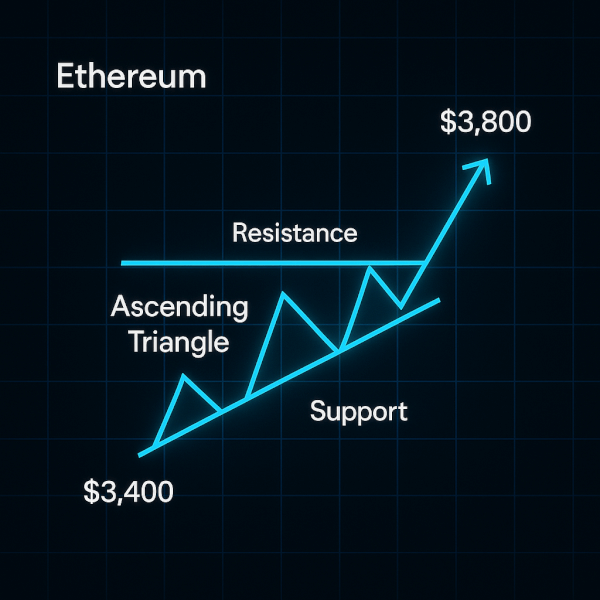
Beyond simple support and resistance, several technical patterns and indicators are signaling bullish continuation. Ethereum’s price action on the daily chart appears to be forming an ascending triangle pattern. This pattern is characterized by a rising trendline of higher lows pressing up against a horizontal resistance level. It typically resolves with a breakout to the upside, with a price target often measured by the height of the triangle.
Furthermore, key momentum indicators support this bullish outlook. The Relative Strength Index (RSI) is holding steady in bullish territory, above the 50 midline, but is not yet in the ‘overbought’ region above 70. This suggests there is still plenty of room for price growth before the trend becomes exhausted. Investors are also closely watching the major moving averages. A potential ‘golden cross’—where the 50-day moving average crosses above the 200-day moving average—could be on the horizon. This is widely regarded as one of the most definitive long-term buy signals in technical analysis.
Ecosystem and macroeconomic tailwinds
The impact of the ‘dencun’ upgrade and lower fees
A network’s value is intrinsically linked to its utility. The recent Dencun upgrade, which introduced proto-danksharding via EIP-4844, has been a game-changer for the Ethereum ecosystem’s scalability. By creating a separate channel for Layer-2 solutions to post transaction data, the upgrade has drastically reduced transaction fees on popular networks like Arbitrum, Optimism, and Base.
These lower fees make decentralized applications (dApps) on Ethereum more accessible and affordable for the average user, spurring innovation and adoption. As more users and developers flock to the ecosystem to take advantage of its enhanced capabilities, the intrinsic demand for ETH—the network’s native asset used to pay for transactions and secure the network—naturally increases, supporting a higher long-term valuation.
Broader market conditions and Federal Reserve policy
Cryptocurrencies, like other risk assets, are heavily influenced by the macroeconomic environment. Currently, market participants are closely monitoring the stance of the U.S. Federal Reserve. According to analysis from financial outlets like Reuters, the consensus is shifting towards an expectation of loosening monetary policy later in the year.
Potential interest rate cuts by the Fed would likely weaken the dollar and increase investors’ appetite for assets with higher growth potential, like Ethereum. In this ‘risk-on’ environment, capital tends to flow from lower-yielding government bonds into equities and digital assets. An accommodative monetary policy from the world’s most influential central bank could provide the macroeconomic tailwind needed to push Ethereum and the broader crypto market to new highs.
Key takeaways: bull case for Ethereum at $3,800
- Institutional Demand: Spot ETFs are creating a new, regulated, and significant source of demand for ETH.
- Whale Accumulation: On-chain data shows large holders are consistently withdrawing ETH from exchanges, indicating a long-term holding strategy.
- Supply Squeeze: The amount of ETH available on exchanges is near multi-year lows, setting the stage for a potential supply shock.
- Technical Strength: ETH is holding critical support levels and showing signs of forming bullish continuation patterns.
- Ecosystem Growth: Network upgrades like Dencun are enhancing Ethereum’s utility and competitive positioning.
Potential risks and headwinds to consider
A balanced analysis requires acknowledging the potential risks that could invalidate the bullish thesis. While the data is promising, investors should remain aware of several headwinds.
Regulatory uncertainty and scrutiny
The regulatory landscape for digital assets remains a significant variable. While the ETF approval was a major step forward, the broader classification and treatment of cryptocurrencies are still being debated by bodies like the Securities and Exchange Commission (SEC) and other global regulators. Any unexpected or harsh regulatory action could introduce fear into the market and stall momentum.
Macroeconomic volatility
The macroeconomic outlook is not guaranteed. If inflation proves to be more persistent than anticipated, the Federal Reserve could be forced to delay interest rate cuts or even maintain a hawkish stance. Such a ‘risk-off’ scenario would likely strengthen the dollar and dampen investor appetite for assets perceived as speculative, including Ethereum. The risk of a broader economic recession also looms, which would negatively impact all markets.
Competition from other layer-1 blockchains
While Ethereum is the undisputed leader in the smart contract space, it does not operate in a vacuum. Competing Layer-1 blockchains such as Solana and Avalanche continue to innovate, offering high speeds and low transaction costs that attract users and developers. Though Ethereum’s network effect is a powerful moat, the continued growth of these competitors is a long-term factor that investors must monitor, as it could chip away at Ethereum’s dominant market share over time.
Frequently asked questions
What is an Ethereum whale?
An Ethereum whale is an individual or entity that holds a very large amount of Ethereum, typically considered to be 1,000 ETH or more. Their buying or selling actions can have a noticeable impact on the market price due to the size of their trades.
How do spot ETFs affect Ethereum’s price?
Spot ETFs affect Ethereum’s price by providing a regulated and accessible way for institutional and retail investors to gain exposure, which increases overall demand and reduces the available supply as ETF issuers must buy and hold real ETH.
Is Ethereum a good investment right now?
Based on the on-chain and technical data, there are strong bullish signals for Ethereum. However, all investments carry risk, including regulatory and macroeconomic factors. This article provides analysis, not financial advice, and investors should conduct their own research and consider their own risk tolerance before making any investment decisions.
Conclusion: is a breakout to $3,800 imminent?
The evidence presents a compelling, data-driven case for Ethereum’s continued strength. The confluence of factors—strong institutional demand flowing through newly approved ETFs, clear on-chain accumulation by the market’s largest players, and a shrinking supply on exchanges—is building a powerful foundation for a significant price appreciation. Technical patterns are reinforcing this bullish outlook, while ecosystem upgrades are enhancing Ethereum’s fundamental value.
While the path to $3,800 is not guaranteed and significant risks related to regulation and the macro-economy remain, the weight of the evidence is tilted firmly to the upside. The foundation for a major rally is being meticulously built, block by block. The question appears to be not just ‘if’ Ethereum will make its next major move, but ‘when’—and the actions of whales and institutions will be the key catalyst to watch.
For ongoing analysis of the crypto market’s biggest movers, subscribe to the cryptoreportnews.com newsletter.