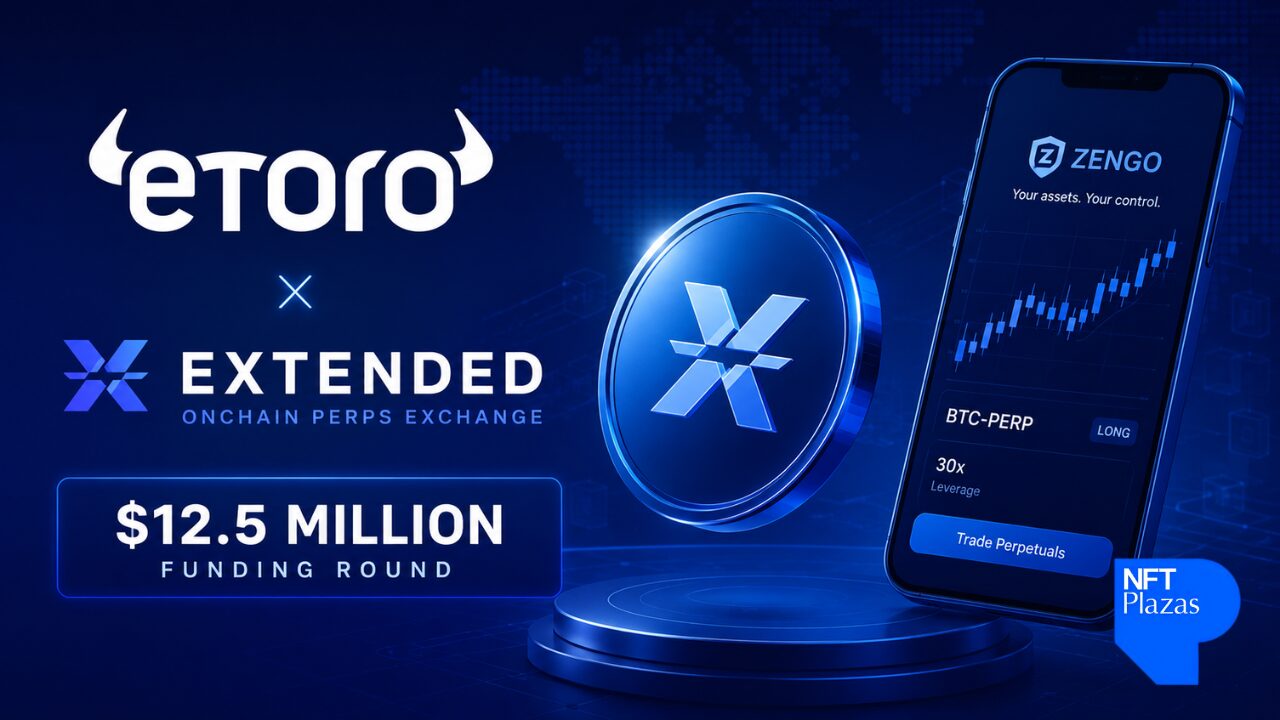
Retail trading platform eToro is expanding its decentralized finance ambitions after leading a $12.5 million strategic funding round for Extended, an on-chain perpetual futures exchange founded by former Revolut executives. The investment signals eToro’s latest move to bridge traditional finance with blockchain-based trading infrastructure following its recent acquisition of self-custody wallet provider Zengo.
The funding round, announced by Extended on July 2, also included participation from Jump Crypto and investment firm Alber Blanc. Rather than serving as a standalone investment, the deal is closely tied to a broader partnership that will see Extended’s perpetual futures technology integrated into Zengo, enabling users to trade on-chain derivatives while retaining full control of their digital assets.
eToro Builds a DeFi Ecosystem Around Zengo
The Extended investment represents the next phase of eToro‘s Web3 strategy after agreeing to acquire Zengo for approximately $70 million earlier this year. The acquisition was designed to strengthen eToro’s self-custody capabilities while laying the foundation for blockchain-native financial products.
Under the new partnership, Extended’s perpetual futures engine will be integrated directly into the Zengo wallet, allowing users to access decentralized derivatives without surrendering custody of their crypto holdings. Zengo’s multi-party computation (MPC) wallet architecture eliminates the need for traditional seed phrases while maintaining user ownership of private keys. The wallet already supports token swaps, staking, and decentralized application access, making it a natural gateway for additional DeFi services.

Beyond derivatives, eToro has indicated it intends to gradually expand the availability of decentralized finance products across its broader trading platform. The company said the partnership aims to improve access to global financial markets through next-generation on-chain infrastructure while exploring ways to connect traditional financial assets with decentralized trading environments.
The strategy also comes as eToro looks to diversify its crypto business. The company has been expanding beyond spot trading into infrastructure and self-custody solutions, reflecting growing demand among investors for blockchain-based financial products that do not rely on centralized intermediaries.

eToro leads $12.5 Million Round In Onchain Perps Exchange Extended
Extended Targets Institutional-Grade On-Chain Trading
Extended was founded by former Revolut employees, including CEO Ruslan Fakhrutdinov, with the goal of bringing professional-grade derivatives trading to decentralized markets.
The exchange is built on StarkWare‘s StarkEx scaling engine, enabling high-throughput trading while settling transactions on Ethereum. Unlike centralized futures exchanges, Extended allows users to maintain custody of their assets throughout the trading process while benefiting from execution speeds designed for active traders.
Perpetual futures, commonly known as “perps,” have become the dominant derivatives product in crypto markets because they have no expiration date and allow traders to maintain leveraged positions indefinitely through periodic funding payments.
Since opening public trading in late 2024, Extended has steadily expanded its offering. The platform now supports more than 100 perpetual markets and has reportedly processed over $245 billion in cumulative trading volume as of June 2026. Future roadmap items include spot trading, tokenized real-world assets (RWAs), unified margin functionality, and multi-asset collateral support.
Traditional Brokers Race Toward On-Chain Perpetuals
eToro’s investment reflects a broader industry trend as traditional brokerages increasingly embrace blockchain-based derivatives instead of building proprietary infrastructure from scratch.
Just one day before the Extended announcement, Robinhood unveiled its own expansion into perpetual futures through Lighter alongside tokenized stocks and other decentralized finance products for European users. Meanwhile, major crypto platforms including Coinbase have expanded their own derivatives offerings, while prediction market operators such as Kalshi and Polymarket have also entered perpetual-style markets.
The growing competition has fueled what many industry observers describe as the race to become an “everything exchange”—a platform combining traditional investing, crypto trading, tokenized assets, derivatives, payments, and decentralized finance within a single ecosystem.
Perpetual DEXs Continue to Gain Market Share
The timing of eToro’s investment coincides with accelerating adoption of decentralized perpetual futures exchanges.
According to CoinGecko’s 2026 Crypto Perpetuals Report, decentralized exchanges have steadily captured a larger share of the perpetual futures market. Open interest on perpetual DEXs increased from approximately 3.6% in early 2025 to 13.5% in 2026, even as centralized exchanges such as Binance and OKX continue to dominate overall trading volumes.
That growth is attracting both venture capital and established financial firms seeking exposure to on-chain market infrastructure. Rather than competing directly with decentralized exchanges, brokerages are increasingly partnering with crypto-native platforms that already possess the trading technology while contributing regulatory expertise, customer distribution, and mainstream user acquisition.
For eToro, backing Extended provides a direct entry point into one of crypto’s fastest-growing market segments while reinforcing its broader strategy of combining traditional investing with decentralized finance. As more financial institutions explore tokenized assets and blockchain-based trading, partnerships between retail brokers and DeFi infrastructure providers are likely to become increasingly common.